Showing posts with label Hastings. Show all posts

Friday, February 27, 2026

Ponbay Bridge

On Elphinstone Road, between Fearon Road and Blacklands Drive,  is a zebra crossing. What many don't notice these days is that this crossing marks the position of the old, wooden Ponbay Bridge (also called Pond Bay Bridge (see left map in Image1) and Ponby Bridge).

The bridge was where the parts of Ore Valley Stream called Manser Brook and Pond Brook met. The stream ran down from the Ridge toward Beaconsfield Road. Although there's no longer an obvious stream (a culvert now running under the road), there are still railings over the 'ditch' or channel to mark where the brook once trickled through the dip of the valley. The stream continues on toward Alexandra Park and is one of the two sources of the Priory Stream.

The name 'Pond Bay' was often used where there was an iron works. Considering, also, the name of 'Ore', it's likely the bridge was so called because an ironworks was located around there. The area was once stripped of most of its trees to fuel the furnaces to smelt the metal, the Romans being a big part of that in Hastings. The iron was then carried northward toward Bodium. J. Manwaring-Baines (1910-2002), author of Historical Hastings, suggests the stream might have been dammed in this spot to provide watermill power. Also, iron slag has been found in the area.

Another theory about the name is that it might have been shortened from 'Pond by the Bridge' (in the same way as Goodbye is shortened from 'God be with thee'.)


Image1: Elphinstone Road, 2025 (right)
was once called Ore Lane, 1763 (left)


In 1858, the repair of the bridge was put out to tender on 16th August.  Tenders were received from:
  • Nathaniel Winter, builder, Coburg Place, Hastings (30th August) 
  • Frederick Button, 5 Providence Road, Hastings (30th August)
  • James Broadbridge & Son, 1 Coburg Place, Hastings (23rd August)

Nathaniel Winter won the tender in September 1858.

Twenty years later, in 1880, the road was barely used -- its terrible state made travelling by carriage too difficult. Because the road was privately owned, it was considered to be up to local landowners to fix it. So, on 3rd December, when the council was asked to help repair it, they refused. One councillor, Councillor Weston, argued along with trustees of the Frewen Estate, who owned the area (and which became Blacklands) to have a brick bridge replace the wooden bridge so that it could be used as the area developed up toward the Ridge.The other councillors disagreed, stating that it was outside of the town's interest and they weren't willing to pay townspeoples' rates (taxes). Even so, two years later, the council did in fact pay £130 toward the cost of the new brick bridge.

In the following image, I have taken the roads and fields of 1763 image and overlaid them onto a recent map as well as I could, highlighting them in red. Ore Lane/Elphinstone don't match up exactly, but well enough to see how the fields and roads lined up with how it is today. The Pond Bay (Ponbay/Ponby) Bridge is marked in yellow:


Image2: Elphinstone Road overlaid
with the originl Ore Lane
and the bridge marked in yellow.

When you look closely, you can see how current roads and developments were influenced by the shapes of the original fields.


Monday, February 2, 2026

URGENT -- Save St Helen's Wood!

3RD FEBRUARY 2026

COME TO THE PUBLIC MEETING!


ACTION NEEDED NOW!

St Helen's Wood is ancient woodland. According to WWF "Ancient woodland covers only 2.5% of the UK. Sadly, up to 70% of ancient woodlands in the UK have already been lost." Are we really going to stand by and let developers harm what little we have left?

If you can
Object to the new Sandrock Bends plans (deadline 12th Feb 2026)
Do whatever you can!
Click HERE to help

Click HERE to help

Click HERE to help


New town plan consultation due to start 14th February
- make your voice heard
(you have six weeks before consultation closes)

For a Larger Image CLICK HERE


Sunday, December 21, 2025

Parochial Rooms, Hughenden Road

Church-Supported Social Clubs

Contents:


No. 5 (originally no. 3) Hughenden Road


No. 5 Hughenden Road used to be No. 3 before
buildings were erected on the opposite side of the road.

Originally, houses were only built on the north side of Hughenden Road, so they were numbered 1,2,3 on the same side. But, when houses were later built on the opposite side, they were renumbered odd numbers on the north side and even numbers on the south side. And what was once number 3 Hughenden Road is now No. 5, next door to Hughenden Garage.

Back in 1882, when Hughenden Road was still only developed on the north side, the private building of no. 3 Hughenden Road (now no. 5) was used by local men as a social club. 

From the moment Alfred Hodges [coming later to Blacklands & Beyond)] took over the local church in Laton Road in 1878, before he even became the official vicar, he demonstrated to the parishioners what a caring, considerate man he was. He worked tirelessly (and without pay for many years) to connect to all the people in the area he cared for. 


To start with, when there were only a few households, Hodges visited them every day. Later, he made every effort to continue regular visits. He got to know the people in the area very well, and cared about their well-being. An advocate for all levels of society, no matter whether a poorer tradesman or a person of substance, he got to know and understand every local man and family, and one of his concerns became the problems and issues of alcohol and its use by his parishioners, in particular the role of the many local public houses.

Hodges decided his parishioners needed an alternative to alcohol and an alternative to public houses.

Soon after No 3 (now 5) Hughenden Road was subscribed for, then opened in the winter of 1881-82. Later, in November 1882, Hodges established The Christ Church (Blacklands) Working Men's Institute as that alternative. The Institute gave men space where they could meet up, play games, read newspapers and socialise when they returned from work, from six o'clock to ten o'clock every evening.

No. 5 Hughenden Road
The original Parochial Rooms

Originally, there were forty-six men paying the one penny subscription per week. They were also obliged to attend Sunday service as part of the cost of using the club. In 1883, one of the members of the Working Men's Institute, George Austin, became the builder of the new school building beside the church. Back then, he had his workshops behind the Institute, and prefabricated much of the new school building in them.

Later, In 1893, Hodges founded a parochial club for boys and young men, called the Junior Institute, or Lad's Club. The club was open to boys of age fourteen to twenty-one years, one of the first 'youth clubs'. Like the Men's Intitute, the rooms were open every evening for the youths to read and play games. Their payment was a small subscription fee and two Bible classes a week.

Hodges wanted to expand the busy parochial clubs already in use to also having a permanent site for a Sunday School for the boys, but there wasn't enough room in the small private building. This was discussed at the Easter Vestry in 1894, after which the sum of £225 was offered toward a plot in Hughenden Road. However, the cost of building had been estimated as £1500. They had, by then, the donations, or promise of donations, of £700. They decided that a mortgage of the other £800 at 4% a year would cost them no more than the £25 they then paid for the current Parochial Rooms in rent.

(back to contents)

No. 28-30 Church House

28B Hughenden Road, Church House, built 1896

The land was purchased from a Dr Goodwin in 1895. Then came a long legal battle before they could start building the new property, they planned to call Church House. It cost £172 in legal fees to relocate an ancient footpath which passed through the site.

 Later that year, the foundation stone was laid by Reverend Hodges wife, Lucy, on 25th September 1895. The sun was shining and all of Hughenden Road was decorated with flags in celebation. The street was filled with residents coming out to cheer on 'Mrs Lucy', who they adored. The building of the Boys Schoolroom and Club Rooms had begun.


Church House, The Parochial Rooms of Blacklands
home of the Boys Sunday School and the Mens Club

A Mr W. E. Warman's tender for the Hall was accepted, and the first Trustees were: the Vicar (Hodges), Wardens, Mr. Dobell and Mr. Forrest.

The deeds stated that the 

'Church House was to be used in perpetuity for Church of England purposes in connection with the Church and Parish of Christ Church, Blacklands'.

So, knowing that it is now residential, at some point a change-of-use must have occurred.

On 24th March 1896, Church House was dedicated by Dr Ernest Wilberforce, the recently consecrated Bishop of Chichester and friend of Reverend Alfred Hodges.

When Church House opened, membership was initially limited to men over the age of 18yrs and who lived in the Parish or who attended the Blacklands Church in Laton Road. There were similar rules to the old parochial rooms, in that there should be no alcohol nor gambling (or any games for money). Thirty-four men became members on opening night. Soon afterwards, there were seventy members, each paying a subscription and attending a Sunday afternoon Bible Class, which the members were obliged to go to.

The front no longer says "Christ Church Blacklands Church House", but now simply says "Blacklands" - it was one of the first things that interested me in the Blacklands area.

28 Hughenden Road now called "Blacklands"

***

P.S. I'm not sure what happened to the Lads Club at that point, if membership was only for over 18s, but in 1908, the Lads Club, or Lads Brigade, as it was then known, moved to Sutton Memorial Hall.


Further Reading:

Christ Church, Blacklands (The Centenary History of a Late Victorian Church); Ralph, Richard; Hastings 1981

History of the Church and Parish of Christ Chrch, Blacklands, Hastings 1878-1928; Morgan, Rev. James, D.D.; Budd A. Gillatt, St Leonards on Sea 1928

Blacklands History, 1066 Online 


(back to contents)

Saturday, May 11, 2024

Aurora Over Blacklands

I intend for this blog to be a place where I post all things Blacklands, particularly historically. However, last night, I feel history was made here as it was throughout the UK.

The sun has chosen the next couple of days to fire zillions of particles from sunspots directly at Earth, causing a G4 strength on the scale of Geomagnetic storms, which is considered 'severe'. Today it will  weaken to level G3 (still there but not so bright).

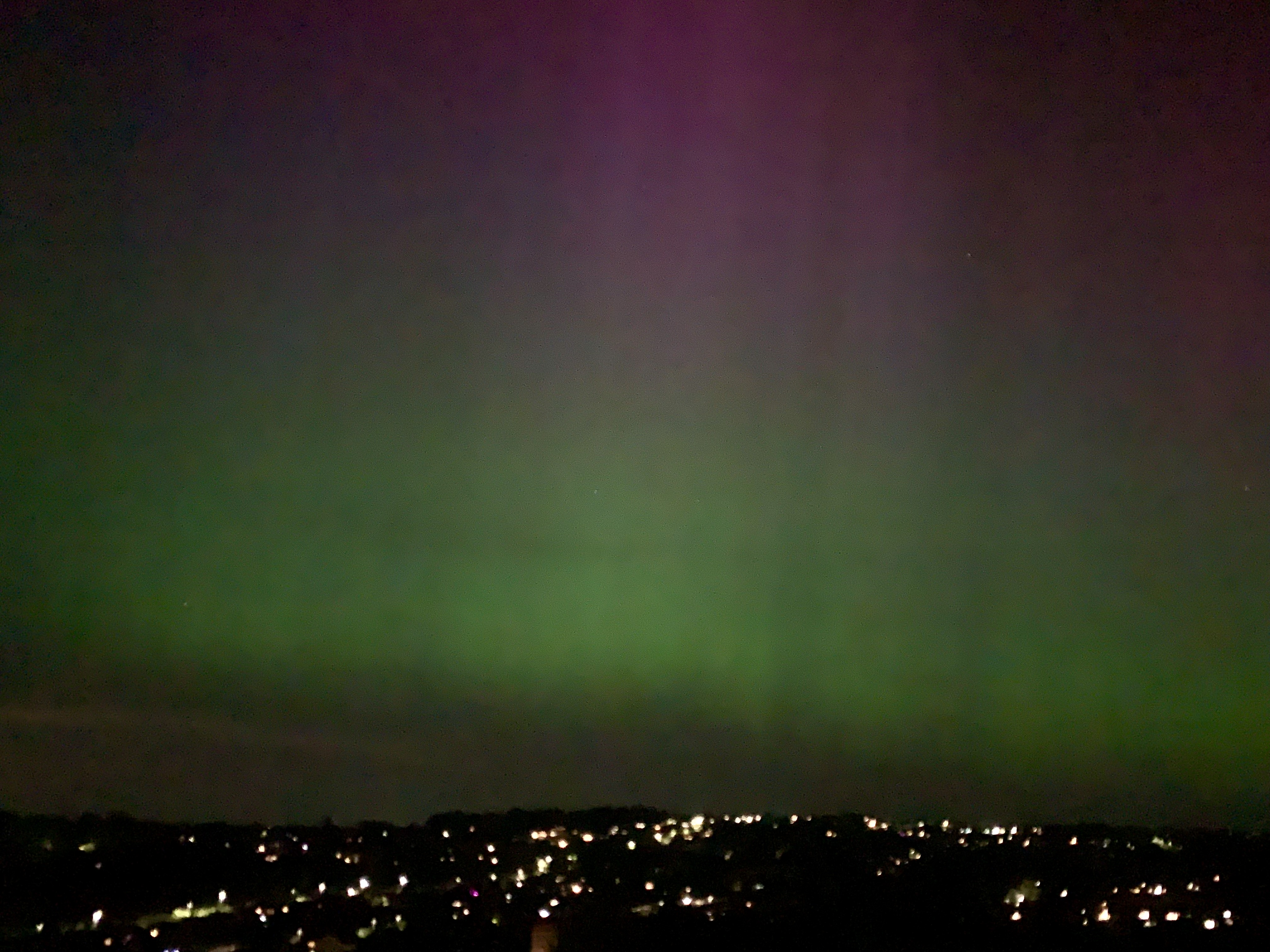
Last night, all over the UK and as far south as Italy, the reaction of those particles with our atmosphere created one heck of a lovely show... I never thought I'd see the Northern Lights as far south as Hastings, let alone that pictures of it were taken over the Matahorn!

Strangely, when my daughter called me over to look, I didn't see much at first. I thought maybe I could see a bit of a green tinge to the cloud to the north (much of which is Blacklands by the way), but it wasn't until a streak of red showed itself over to the East I could really see it.

Having unsuccessfully tried to take night-time photos on my phone before, and not believing the Aurora Borealis would show up in pictures, I nevertheless faced the camera to the beautiful sight. Amazingly, even when it wasn't bright, it showed up on the camera! So, guess who then took zillions of photos... yep! One for each particle aimed at Earth, give or take a few zillion.

Because the pictures look out over Blacklands, I feel a little justified in sharing a few of them here (sorry if some of them are not very clear; my phone isn't brilliant):


Mount Pleasant Crescent

Some of the houses of Mount Pleasant Crescent Mount Pleasant Crescent is a twitten running from Cromer Walk to Elphinstone Road. Most of the...